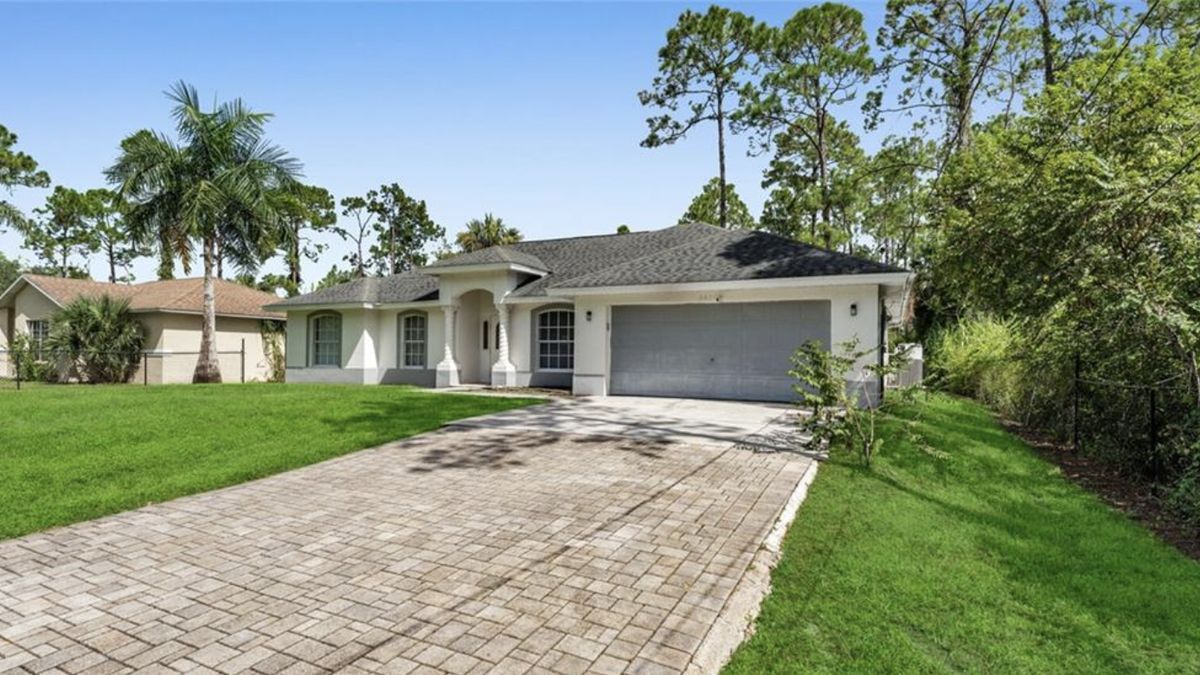
Order two inspections that a normal home inspector does not perform, and test the water before your inspection period closes. Buying a home with a well and septic in Naples means you are taking title to two pieces of private infrastructure, and the failures are expensive. A drainfield replacement runs five figures. A new well is not far behind. Neither one shows up in a standard inspection report.
Where the wells are around Naples
Golden Gate Estates is the big one. Almost every home east of Collier Boulevard sits on a private well and a septic tank, and that covers the bulk of the acreage listings I write contracts on. The pattern repeats through eastern Collier County and in pockets of unincorporated Lee County. The coastal side of Naples is mostly on county water and sewer, though older neighborhoods here and there still have a septic tank in the side yard that nobody mentions until the survey comes back.
Sellers are supposed to disclose this. In practice the MLS field is right more often than it is wrong, and the tax bill will tell you fast. If the property is inside the Collier County Water-Sewer District you will see a utility line item. No line item usually means well and septic.
A home inspection does not cover the septic system
A standard inspection is visual. The inspector will run water down a drain and tell you it drains. That is the whole test. To actually know what you are buying, the tank has to be uncovered, pumped, and looked at, and the drainfield has to be evaluated with the tank empty. Budget $300 to $500 for a septic inspection and another $350 to $600 for the pump-out, and expect to pay for both yourself.
The tank is rarely the problem. Concrete tanks last decades. The drainfield is what fails, and it fails quietly for a year or two before anything backs up into the house. Soggy ground over the field in dry season, grass that is greener in one rectangle than the rest of the yard, or a smell after heavy rain all point the same direction.
Test the water, then read the whole report
Two different tests matter. A bacteria test tells you whether the water is safe. A mineral panel tells you what it will cost to live with. Southwest Florida groundwater is hard and heavy on iron and sulfur. Rust staining on fixtures and a rotten egg smell at the tap are normal here, not a defect, and they are solved with equipment rather than with a price reduction.
A whole house treatment setup, meaning an aerator, a filter, and a softener, runs roughly $2,500 to $6,000 installed. A reverse osmosis unit under the kitchen sink for drinking water is a few hundred more. If the house already has treatment equipment, find out how old it is and whether it works, because a system that has been sitting through a vacant listing period often needs service the week you move in.
The FHA and VA rules that kill deals in week three
This is where financed purchases fall apart, and it happens late because the appraiser is the one who raises it. FHA wants the well at least 50 feet from the septic tank, 100 feet from the drainfield (that one can come down to 75 feet if the local health authority allows it), and 10 feet off the property line, with a water test from a certified lab that is good for 180 days. That is HUD Handbook 4000.1. VA is different in a way that trips people up: VA sets no distance of its own. It adopts whatever the local health authority requires, and only falls back to the state standard and then the EPA if there is nothing local. Its water test is good for 90 days rather than 180.
On older Estates parcels, those distances are not always there. A well drilled in 1988 sits where the driller put it. When the numbers do not work you are looking at a health department variance, a new well, or a switch to conventional financing, and none of those happen in three days. If you are buying with FHA or VA money, have your lender confirm the well and septic requirements in writing before your inspection period ends, not after.
Pull the permit history
The Florida Department of Health in Collier County still permits and inspects septic systems here, and their Environmental Public Health Division at 3339 Tamiami Trail East, Building H, Suite 302 can tell you what is on record for the address. The direct line is 239-252-5530. There is no statewide lookup that will pull a septic permit by address, so you file a records request with that office. The permit tells you the install date, the tank size, and the drainfield size, and tank size is worth checking against the house. A three bedroom permit on a home that somebody converted to five bedrooms is a real problem, not a paperwork problem.
Plenty of older Estates systems have no record at all. That is common and it is not illegal, but it means you should treat the age as unknown and inspect accordingly.
What replacement actually costs
A new drainfield in Collier County generally runs $5,000 to $12,000 depending on soil, access, and whether the tank goes with it. A complete new septic system lands in the $10,000 to $18,000 range once permitting and engineering are included. A new well with pump and pressure tank is commonly $6,000 to $12,000. Pumps themselves are a smaller and more frequent expense, in the $800 to $2,000 range, and they die more often here than most buyers expect, because Florida is one of the most lightning-prone states in the country and a nearby strike takes out a well pump's control box without much warning.
How I handle it in the contract
Our purchase contracts are written as is with a right to inspect, so the leverage is entirely in the inspection period, and I schedule the septic and the water test in the first few days rather than the last few. If something comes back bad, the ask is usually a credit at closing rather than a repair by the seller, because a credit lets you pick the contractor and the timeline. Ask for the survey too, since it shows where the well and the tank sit relative to the lines. That is one of the reasons I order a survey on nearly every Estates purchase.
None of this is a reason to avoid the Estates. Acreage, no HOA, and no CDD fee is a real trade for maintaining your own water and waste. It is only a bad trade when nobody checks first.
Have questions about a specific property or neighborhood? Call John at 239-304-6224 or send a message.