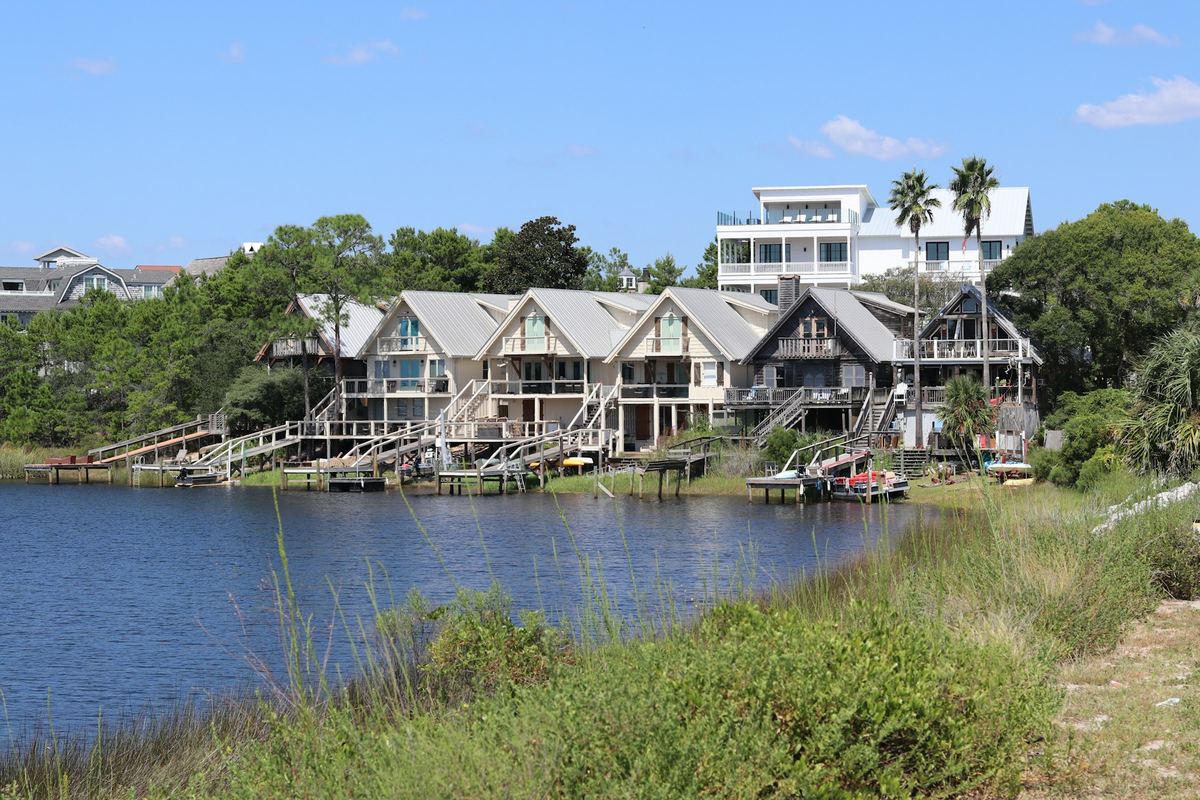
Yes. Every new dock, boat lift, and seawall here needs a building permit, and the state usually has to sign off too. A boat dock permit in Naples is really two or three approvals stacked on each other: the county or the city, the Florida Department of Environmental Protection, and the Army Corps of Engineers behind it. A standard dock on a canal lot moves through in weeks. One that reaches past the size limits goes to a public hearing and takes months.
How far a dock can stick out into the canal
Collier County measures by the width of the water, not the size of your lot. On a waterway 100 feet wide or more, the dock and the boat tied to it together cannot reach more than 20 feet out. On anything narrower, the limit is 25 percent of the waterway width or 20 feet, whichever is less. Unreinforced manmade canals 60 feet or narrower can go to 33 percent if you follow the review procedure in the code.
Side setbacks run off your water frontage instead. Sixty feet of frontage or more and the dock stays 15 feet off the riparian line. Under 60 feet it drops to 7.5 feet, and end lots and side-end lots on a canal get 7.5 feet as well.
The county takes protrusion from the most restrictive of the property line, bulkhead line, shoreline, seawall, rip-rap line, control elevation contour, or mean high water line. Measure from the wrong one and the plan comes back.
What happens when you need more than 20 feet
That is a boat dock extension, and it is a petition, not a counter transaction. Staff reviews it and the county's Hearing Examiner decides after a public hearing. Budget $1,500 for the petition, $500 for the required pre-application meeting (credited toward review if you apply within nine months), roughly $50 per legal ad, $150 for fire planning review, and $1.50 to $3.00 for each mailed notice. You also post a sign on the property and track down the current addresses for registered homeowner and civic associations within 1,000 feet.
Approval takes at least four of five primary criteria and four of six secondary criteria. The ones that sink petitions are predictable: protruding past 25 percent of the waterway, leaving less than half the channel open between the docks on either side, and mooring a vessel longer than half the property's linear waterfront footage. A boathouse is harder still. Seven of seven criteria, a 15 foot side setback, 15 feet of height measured from the top of the seawall, open on all four sides, one per property, and a roof that overhangs the protrusion limit by no more than three feet.
What a boat dock permit costs through the county
Collier reviews docks, boat lifts, and seawalls under one Marine permit type. The submittal is a site plan signed and sealed by a surveyor, engineer, or architect showing the proposed structure, the canal width, and the protrusion measurement, plus construction plans for the work itself. A licensed marine contractor normally pulls it. If you act as your own contractor, the owner builder application has to be signed in person and notarized by Growth Management staff.
If you are building new, the rest of the county's permit math is in what impact fees cost in Collier County.
The state and federal permits behind it
One application to FDEP triggers three reviews: the environmental resource permit, consent to use state-owned submerged lands, and federal authorization through the Army Corps State Programmatic General Permit.
Most single-family docks never need a full permit at the state level. Florida law exempts a private dock of 1,000 square feet or less of over-water surface, and that drops to 500 square feet in Outstanding Florida Waters, which takes in the aquatic preserves around Rookery Bay and the Ten Thousand Islands. The structure has to sit on pilings or float, it cannot impede water flow or create a navigational hazard, and it has to be the only exempt dock along 65 feet of shoreline.
Past that, a general permit covers up to 2,000 square feet and no more than two vessels. Anything bigger is an individual permit. FDEP's published fees are $100 for an exemption, $250 for a general permit, and $420 for an individual permit, with review running about 30 days for the first two and about 60 for the last. There is an online self-certification route that handles new docks, lifts added to an existing dock, and like-for-like replacement.
Inside the city of Naples the rules change
City lots do not go through the county. Naples runs its own marine permit, and the dock fee is 30 cents per gross square foot with a $100 minimum, plus 20 percent of that for plan review and a $25 zoning fee. The city wants an aerial showing the neighboring piers, electrical load calculations if the run is over 30 amps, sealed engineered drawings for any seawall, and a final survey before it will close the permit out. Port Royal carries its own deed restrictions and the POA approves first. Bald eagle nesting season runs October 1 through May 15 and can shape how a contractor schedules the work. Marco Island is a separate city with its own dock extension petition.
What to check before you buy a waterfront home
Pull the permit history on the dock that is already there. An unpermitted or expired structure becomes the new owner's problem at closing, and curing it can mean an after-the-fact permit or a trip to the Hearing Examiner.
Measure for the boat you actually own. Water depth at low tide, canal width, and every bridge between the lot and the Gulf. A 20 foot protrusion limit and three feet of water at low tide rule out a lot of boats that look fine next to the listing photos.
Read the association documents. HOAs and condo associations regularly cap vessel length, prohibit boathouses and lifts, or assign slips separately from the home. The county can approve a dock the association still refuses. Waterfront changes the insurance math too, which I went through in how flood insurance works in Naples.
If the dock matters more than the kitchen, tell me that at the start. I would rather write the offer around a dock extension or hold out for a deeper canal than find out during inspections that the boat will not fit under the bridge.
Have questions about a specific property or neighborhood? Call John at 239-304-6224 or send a message.